![[등록] 2026-09-01 15:48:31](/support/_updata/banner2/tl181982910_6749.png)


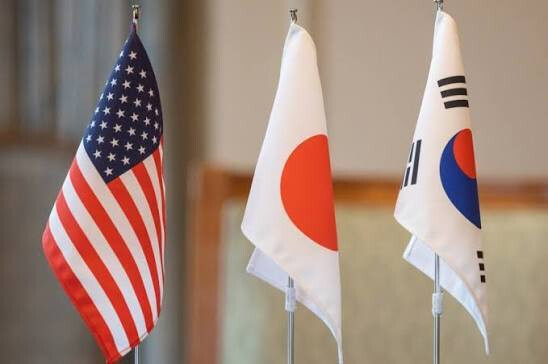
NEW YORK — The Foreign Ministers of South Korea, the United States, and Japan reaffirmed their commitment to the complete denuclearization of North Korea while urging Pyongyang to return to dialogue on the 21st (local time). Targeting China, the three nations emphasized the importance of maintaining peace and stability in the Taiwan Strait and agreed to strengthen their trilateral early warning system for supply chains to counter "economic coercion."
The Ministry of Foreign Affairs announced that Foreign Minister Cho Hyun met with U.S. Secretary of State Marco Rubio and Japanese Foreign Minister Toshimitsu Motegi in New York to agree on a joint statement containing these key points.
In the joint statement, the three ministers "reaffirmed their unwavering commitment to the complete denuclearization of North Korea and the prohibition of revenue generation supporting its nuclear and ballistic missile programs, in accordance with United Nations Security Council resolutions."
The statement added, "Reaffirming that the path to dialogue remains open, we urge North Korea to return to negotiations and will continue efforts to promote peace and stability on the Korean Peninsula."
The ministers also discussed peace and stability in the Taiwan Strait. The joint statement noted, "The ministers encouraged a peaceful resolution of cross-strait issues, opposed any unilateral attempts to change the status quo, and expressed support for Taiwan’s meaningful participation in appropriate international organizations."
Targeting China, the statement declared, "We firmly oppose economic coercion and non-market policies and practices that cause harmful overproduction and market distortion—including arbitrary export restrictions that disrupt supply chains—while continuing free and transparent trade and securing critical supply chains."
To this end, the three ministers stated they "agreed to strengthen the trilateral supply chain early warning system and welcomed the launch of a new economic security consultative body among the three countries."
Cooperation in nuclear energy and advanced technologies will also be reinforced. The joint statement stated, "We will push forward with the implementation plan for the trilateral Memorandum of Cooperation (MOC) adopted on July 7 to accelerate the deployment of Small Modular Reactors (SMRs) in third countries." Furthermore, they agreed to jointly strengthen advanced technology stacks and supply chain resilience while promoting and protecting critical and emerging technologies such as artificial intelligence (AI), quantum technology, digital infrastructure, and biotechnology.
The trilateral foreign ministers' meeting was held on the sidelines of the high-level segment of the 81st United Nations General Assembly. This marks the third meeting in three months, following previous gatherings on July 7 on the margins of the NATO summit in Turkey and July 22 on the margins of the ASEAN Regional Forum (ARF) in the Philippines.
[Copyright (c) Global Economic Times. All Rights Reserved.]