![[등록] 2026-09-01 15:48:31](/support/_updata/banner2/tl181982910_6749.png)


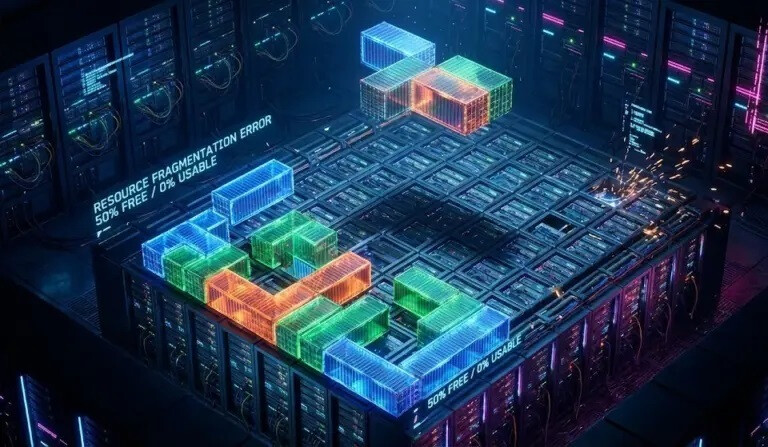
In the hyper-competitive global race for artificial intelligence dominance, corporate titans and enterprise software leaders have spent billions securing scarce, highly coveted Graphics Processing Units (GPUs). Yet, behind closed data center doors, a striking paradox has emerged: the vast majority of this astronomical compute power sits completely idle. A comprehensive global study reveals that enterprise GPU utilization stands at an astonishingly low 5%, signaling that hardware accumulation alone is failing to translate into real-world AI productivity.
According to benchmark data released on July 31 by global cloud optimization firm CAST AI, an extensive analysis of approximately 23,000 production clusters across the top three cloud service providers—Amazon Web Services (AWS), Microsoft Azure, and Google Cloud—demonstrated that enterprise systems operating without optimized Kubernetes orchestration achieve an average GPU utilization of merely 5%. This leaves approximately 95% of available GPU capacity inactive at any given moment, far below the industry’s recommended operational target of 50%.
Diagnosing the Compute Bottleneck
Industry experts attribute this structural waste to several converging factors:
Capital Over-provisioning: Fear of missing out (FOMO) and aggressive capital allocation have compelled enterprises to over-provision GPU capacity well ahead of actual operational demand.
Coarse Architectural Sharing: Architectural bottlenecks—such as low frequencies of GPU time-slicing and crude resource sharing—prevent multiple workloads from efficiently coexisting on single silicon units.
Lack of Automated Scheduling: A prevalent lack of dynamic automated resource optimization causes high-performance chips to idle while waiting for data pipelines, pre-processing tasks, or scheduled batch jobs.
The consensus among international cloud architects and data center strategists is clear: acquiring raw silicon represents only the foundational baseline of AI readiness. The true competitive frontier in enterprise AI lies in building seamless integration across data center physical architecture, cloud orchestration platforms, inference optimization software, and operational telematics. Without this unified software fabric, capital expenditures on hardware yield diminishing returns.
South Korea’s AI Innovators Spearhead Layered Solutions
In response to this global efficiency crisis, a group of prominent South Korean AI infrastructure startups is deploying targeted technological solutions across every layer of the hardware and software stack—from physical data center engineering to deep model compression and real-time observability.
Elice Group (End-to-End Infrastructure Integration): Elice Group has tackled the utilization crisis through a holistic approach that bridges physical facility design with cloud management. By pairing its specialized modular data center architecture—Elice AI PMDC—with its proprietary cloud infrastructure software suite ECI, Elice enables tailored module deployment, rapid dynamic expansion, advanced GPU virtualization, and intelligent workload scheduling. Through unified data center governance and multi-cluster monitoring, Elice eliminates operational silos, maximizing effective compute throughput.
"Competitiveness in AI infrastructure is not determined by raw GPU headcount, but by how rapidly and reliably those resources are mobilized into active service. The goal is to deliver higher effective compute and token output for the exact same capital expense."
— Park Jung-gook, Chief Technology Officer at Elice Group
Nota AI (Software Compression & Quantization): Taking an algorithmic approach to hardware efficiency, Nota AI leverages proprietary model optimization tools to compress heavyweight models so they run on significantly smaller hardware footprints. In a flagship project optimizing Upstage’s Solar Open 2 under the national Independent AI Foundation Model initiative, Nota applied advanced quantization techniques to compress a model that previously demanded 8 GPUs down to run seamlessly on just 2 GPUs—achieving a 75% reduction in hardware requirements without compromising baseline performance.
Lablup (Virtualization & Distributed Training): Lablup addresses compute fragmentation through its enterprise platform, Backend.AI. By providing fractional GPU virtualization and automated distributed cluster training, Backend.AI allows enterprises to slice single physical GPUs into smaller, isolated workloads or aggregate thousands of nodes for large-scale training, dramatically elevating average hardware usage metrics across heterogeneous environments.
FriendliAI & WhaTap Labs (Inference Scheduling & Observability): Recognizing that inference accounts for an increasing share of post-deployment GPU runtime, FriendliAI specializes in request scheduling and dynamic batch optimization to drive down latency and per-token operational costs. Simultaneously, observability leader WhaTap Labs is expanding integrated monitoring solutions that combine physical infrastructure metrics, application workloads, and live AI model telemetry to provide end-to-end visibility into resource bottlenecks.
Shift Toward Token Efficiency and AX Support
The broader ecosystem is rapidly aligning around these efficiency gains. As part of this nationwide drive toward practical implementation, technology providers such as WegoFair were recently selected for the Seoul AI Hub's 2026 AI Transformation (AX) Support Business consortium, underscoring the shift from theoretical AI model development to operational business integration.
As the global AI industry transitions from an era of unchecked capital expenditure into an era of operational discipline, the defining metric of success is shifting from total teraflops owned to cost per million tokens processed. Tech leaders pioneering workload scheduling, model compression, and full-stack orchestration are establishing the blueprint for the next phase of enterprise artificial intelligence.
[Copyright (c) Global Economic Times. All Rights Reserved.]