![[등록] 2026-09-01 15:48:31](/support/_updata/banner2/tl181982910_6749.png)


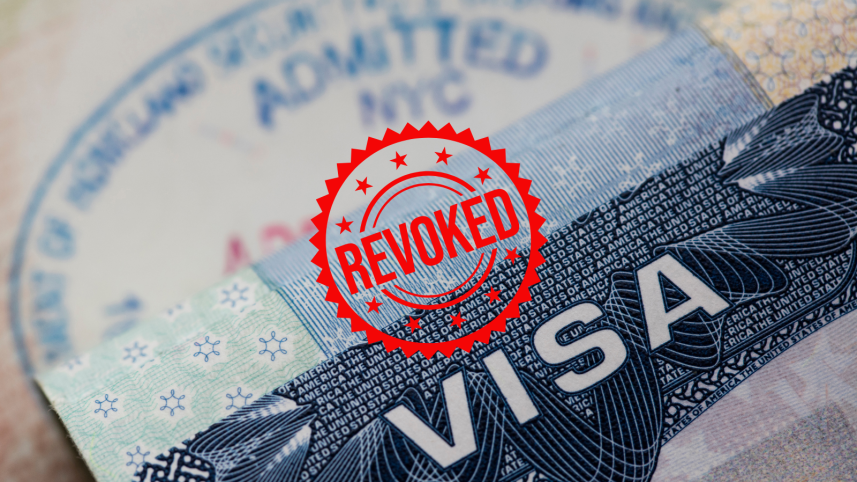
The number of non-immigrant visas issued to South Korean nationals decreased by approximately 8% following the launch of the second administration of U.S. President Donald Trump.
On February 22, the office of Representative Hong Ki-won, the ruling party's secretary for the National Intelligence and Foreign Affairs Committee of the National Assembly, released its own analysis of U.S. Department of State visa issuance statistics by country.
According to the lawmaker's office, South Korea's non-immigrant visa issuance from the U.S. stood at 74,015 in 2024 under the Joe Biden administration. However, this figure dropped by 7.95% (5,885 cases) to 68,130 in 2025 following the transition to the Trump administration.
Visas for business and tourism purposes (B-1 and B-2) decreased from 15,275 cases in 2024 to 14,555 cases in 2025. E-1 and E-2 visas, issued to trading company expatriates and investors, also declined from 6,432 cases to 5,667 cases over the same period.
Furthermore, student visas (F-1) for international students in the U.S. and J-1 visas required for exchange programs and internships shrank from 14,339 to 11,589 cases and from 9,017 to 7,593 cases, respectively.
However, on a monthly basis, there were signs of recovery in certain visa issuances following an incident last September in which more than 300 South Korean workers in Georgia were detained over residency status issues.
Following the Georgia incident, a South Korea-U.S. visa working group was launched. As one of its achievements, a dedicated visa window for South Korean investment companies was opened at the U.S. Embassy in Seoul last December.
Consequently, the monthly average issuance of B-1 and B-2 visas rose from 1,273 cases in 2024 and 1,212 cases in 2025 to an average of 2,027 cases in January and February of this year, the latest available statistics.
Nevertheless, student (F-1) visas continued to show a downward trend, averaging 1,195 cases per month in 2024, 965 cases in 2025, and 273 cases in January and February 2026.
Even when adjusting the timeframe to account for the typical low volume of F-1 visa issuances in January and February, the downward trend remained clear. The monthly average of F-1 visa issuances dropped from 679 cases between November 2023 and February 2024 to 482 cases between November 2025 and February 2026.
Given that the U.S. Department of Homeland Security (DHS) announced regulations limiting international students' stay to four years on July 16, this trend is likely to persist going forward.
In response, the government has been raising concerns across various exchange channels and reportedly reported to the National Assembly that the decrease in non-immigrant visas for South Korea is relatively smaller compared to major countries such as India, China, and Japan.
Rep. Hong Ki-won stated, "This phenomenon is part of a global trend occurring amid the anti-immigration stance declared by the Trump administration. While the decline may be smaller compared to major nations, leaving the situation unattended will inevitably cause significant damage to many students preparing to study in the United States." He added, "We need to mobilize all available U.S. diplomatic channels to normalize relevant visa issuances."
[Copyright (c) Global Economic Times. All Rights Reserved.]