• 2026.03.08 (Sun)
  • All articles
  • LOGIN
  • JOIN
Global Economic Times
fashionrunwayshow2026
  • Synthesis
  • World
  • Business
  • Industry
  • ICT
  • Distribution Economy
  • Well+Being
  • Travel
  • Eco-News
  • Education
  • Korean Wave News
  • Opinion
  • Arts&Culture
  • Sports
  • People & Life
    • International Student Report
    • With Ambassador
  • Column
    • Cho Kijo Column
    • Cherry Garden Story
    • Ko Yong-chul Column
    • Kim Seul-Ong Column
    • Lee Yeon-sil Column
  • Photo News
  • New Book Guide
MENU
 
Home > Distribution Economy

South Korea's Financial Markets Face Turbulence: Stocks, Won, and Bonds All Fall

Hwang Sujin Reporter / Updated : 2025-11-08 06:41:37
  • -
  • +
  • Print

(C) The Japan Times
 

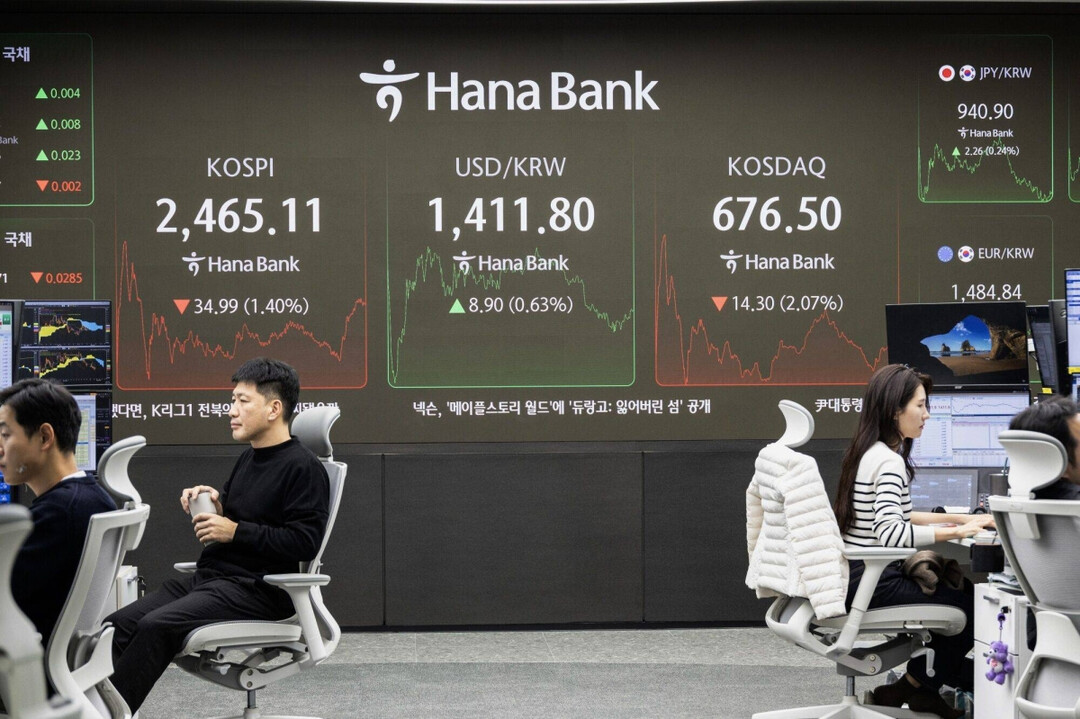
The South Korean financial market is showing clear signs of distress as the KOSPI index, the Korean Won, and government bond (Kukgochae) prices all experience a simultaneous decline. The situation has prompted serious concern regarding the stability of the domestic market.

On November 7, 2025, the KOSPI closed at 3,953.76, down 1.81% (72.69 points) from the previous trading day. This marked the first time the index finished below the crucial 4,000-point level since October 24. Although the KOSPI briefly turned positive in the morning thanks to foreign net buying, the index rapidly reversed course and sharply declined after foreign investors shifted to net selling around 11 a.m. KST, at one point plunging by 3.46% to 3,887.32.

Foreign Investor Exodus and Currency Weakness 

Foreign investors were net sellers of 479.1 billion KRW on the main KOSPI market on November 7. They have now been net sellers for every trading day this month, totaling approximately 7.3 trillion KRW in net sales. Conversely, retail investors have acted as a crucial buffer, having been net buyers throughout the month, purchasing 695.9 billion KRW worth of stocks on the day alone, amounting to around 7.46 trillion KRW in net purchases for the month.

The Korean Won-US Dollar exchange rate closed the week at 1,456.9 KRW per dollar, an increase of 9.2 KRW from the previous day. This represents the highest weekly closing rate since April 9, when concerns over "reciprocal tariffs" were at their peak (1,484.1 KRW). This depreciation of the Won, a so-called "risk currency," is a direct result of heightened global financial market uncertainty.

The market is caught in a vicious cycle of currency depreciation and stock decline. As the Won weakens, foreign capital is drawn away from the domestic stock market. This foreign investor exodus, in turn, accelerates the Won's decline, further pushing down stock prices. The breaking of the 1,450 KRW threshold for the exchange rate was a major factor contributing to the day's significant foreign capital flight.

Bond Market Slump and Economic Headwinds 

The bond market is also in a slump. The yield on the 3-year government bond rose by 0.060 percentage points to 2.894%, and the yield on the 10-year government bond rose by 0.023 percentage points to 3.226%. Higher yields mean lower bond prices. These yields are the highest recorded in a year (since November 18 and July 11 of the previous year, respectively), despite the Bank of Korea having cut the base rate twice this year. The rise in bond yields signals a drop in bond prices.

A bond fund manager noted that the domestic bond market's weakness persists despite the recent strength in U.S. Treasury bonds, citing consecutive days of rising domestic government bond yields and growing concerns over the credit market.

The outlook for the Won remains weak. Experts suggest the Won's depreciation is likely to be prolonged due to the recent strengthening of the US Dollar and a lack of clear factors that would lead to a sustained decline in the exchange rate. The Won's long-term weakness is also being tied to the potential for domestic capital to flow to the US and unresolved issues with domestic demand, suggesting that currency weakness may persist regardless of the stock market's performance. The weakening of the bond market also increases the funding costs for corporations, placing further downward pressure on the overall economy.

Despite the current downturn, some analysts maintain that the stock market is undergoing a necessary "correction phase." They view the current turbulence as a process of "digesting bad news," suggesting that the short-term adjustment may simply be a "comma" in a broader upward trend.

[Copyright (c) Global Economic Times. All Rights Reserved.]

  • #globaleconomictimes
  • #micorea
  • #mykorea
  • #Lifeplaza
  • #nammidonganews
  • #singaporenewsk
  • #Samsung
  • #Daewoo
  • #Hyosung
  • #A
Hwang Sujin Reporter

Popular articles

  • Tzuyang Reveals Massive Expenses: $33,000 Annual Delivery Bill and "Luxury Car" Monthly Income

  • Memoirs of Late Prime Minister Lee Hae-chan Tops Bestseller List Following Presidential Endorsement

  • BTS to Stream ‘ARIRANG’ World Tour Live in 3,500 Theaters Globally

I like it
Share
  • Facebook
  • X
  • Kakaotalk
  • LINE
  • BAND
  • NAVER
  • https://globaleconomictimes.kr/article/1065562791055363 Copy URL copied.
Comments >

Comments 0

Weekly Hot Issue

  • The Death of the Architect's Draft? New AI Engine 'Nano Banana 2' Turns Rough Sketches into Professional 3D Walk-throughs
  • President Lee Celebrates Milestone for ‘The Man Living with the King,’ Pledges to Bolster Cultural Pride
  • Namyangju Targets Gwacheon Racecourse Relocation: A Vision for a "Blue-Green" Mega-Complex Linked to GTX and 3rd Generation New Towns
  • Korean Air Extends Suspension of Incheon–Dubai Route Through March 15 Amid Ongoing Disruptions
  • Genetic 'Molecular Mirror': Blood Tests Challenge Biopsy Limits in Ovarian Cancer Diagnosis
  • Samsung to Revolutionize Health Tracking: Galaxy Watch to Adopt Contact-Based Temperature Sensors for Enhanced Precision

Most Viewed

1
Adwa’s Echo in Korea: A Shared Story of Dignity and Freedom
2
2026, The Grand Year of Hangeul Celebration — The River of History Where Five Streams Converge
3
A New Milestone for Ukraine’s Post-War Reconstruction: The Birth of ISVP
4
Mexican currency and the powerful history behind its designs
5
Revised and Expanded Edition of ‘Failure of Negotiations with North Korea: Truth and Solutions’ Published
광고문의
임시1
임시3
임시2

Hot Issue

The $100 Oil Threshold: Wall Street Braces for a Paradigm Shift as Middle East Conflict Drags On

The Death of the Architect's Draft? New AI Engine 'Nano Banana 2' Turns Rough Sketches into Professional 3D Walk-throughs

Oppo Bridges the Great Divide: Find X9 to Support AirDrop Connectivity

China’s Strategic Gold Rush: Beijing Amasses Reserves for 16th Straight Month Amid Dollar Uncertainty

Let’s recycle the old blankets in Jeju Island’s closet instead of incinerating them.

Global Economic Times
korocamia@naver.com
CEO : LEE YEON-SIL
Publisher : KO YONG-CHUL
Registration number : Seoul, A55681
Registration Date : 2024-10-24
Youth Protection Manager: KO YONG-CHUL
Singapore Headquarters
5A Woodlands Road #11-34 The Tennery. S'677728
Korean Branch
Phone : +82(0)10 4724 5264
#304, 6 Nonhyeon-ro 111-gil, Gangnam-gu, Seoul
Copyright © Global Economic Times All Rights Reserved
  • 에이펙2025
  • APEC2025가이드북TV
  • 독도는우리땅
Search
Category
  • All articles
  • Synthesis
  • World
  • Business
  • Industry
  • ICT
  • Distribution Economy
  • Well+Being
  • Travel
  • Eco-News
  • Education
  • Korean Wave News
  • Opinion
  • Arts&Culture
  • Sports
  • People & Life 
    • 전체
    • International Student Report
    • With Ambassador
  • Column 
    • 전체
    • Cho Kijo Column
    • Cherry Garden Story
    • Ko Yong-chul Column
    • Kim Seul-Ong Column
    • Lee Yeon-sil Column
  • Photo News
  • New Book Guide
  • Multicultural News
  • Jobs & Workers