![[등록] 2026-09-01 15:48:31](/support/_updata/banner2/tl181982910_6749.png)


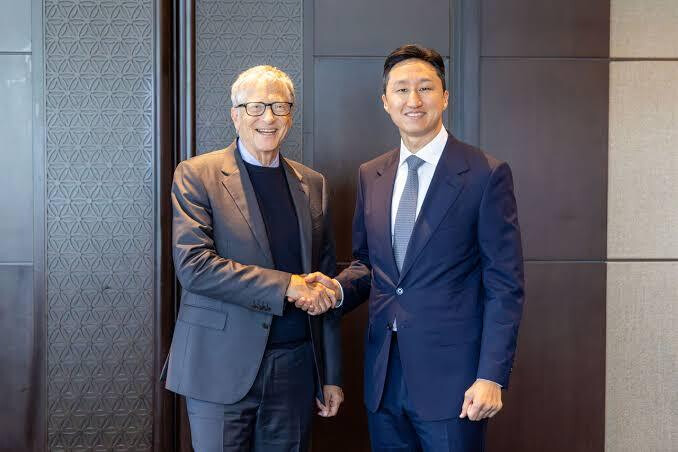
SEOUL — HD Hyundai, a global leader in heavy industry, has moved to cement its position in the burgeoning Small Modular Reactor (SMR) market through a high-level meeting with TerraPower, the advanced nuclear energy firm founded by Bill Gates.
On August 14, HD Hyundai announced that Chairman Chung Ki-sun met with Bill Gates, TerraPower CEO Chris Levesque, and Hyundai Engineering & Construction (HDEC) CEO Lee Han-woo in Seoul. This gathering marks the first official assembly of top leadership from the three entities since they signed a trilateral Memorandum of Understanding (MOU) in May, which established a framework for collaborating on the deployment of sodium-cooled fast reactor (SFR) technology.
Strategic Synergy: Technology, Manufacturing, and EPC
The collaboration is structured to leverage the distinct strengths of each partner. TerraPower provides the proprietary "Natrium" reactor technology—a fourth-generation SMR that utilizes liquid sodium as a coolant instead of water. This design allows for higher thermal efficiency and improved safety compared to traditional light-water reactors. Furthermore, the Natrium plant incorporates an integrated molten-salt energy storage system, enabling the facility to vary its power output to match grid demands effectively.
In this partnership, HD Hyundai is responsible for the manufacturing of major reactor components, including the core reactor vessel. Having been selected as a preferred manufacturer, HD Hyundai is currently scaling its production facilities, with a target output of two to three reactor vessels per year. Meanwhile, Hyundai Engineering & Construction will oversee the Engineering, Procurement, and Construction (EPC) aspects of the projects, ensuring that the advanced reactor designs are successfully brought to life.
"By integrating our respective expertise in technology, manufacturing, and EPC, we expect to significantly accelerate the commercialization of next-generation reactors," stated Chairman Chung Ki-sun. "HD Hyundai will proactively respond to the rising global demand for SMRs through continuous internal innovation and robust international partnerships."
Addressing the AI-Driven Energy Crisis
The urgency behind this partnership is largely dictated by the skyrocketing power requirements of the United States. As the world’s largest nuclear market, the U.S. is currently grappling with a massive demand for reliable, carbon-free baseload power, primarily fueled by the massive energy footprint of AI-driven data centers.
The Natrium technology is uniquely positioned to address this energy gap. By acting as a stable power source that can also store energy, these SMRs offer a flexible solution to the intermittency issues often associated with renewable energy sources. With the U.S. Nuclear Regulatory Commission (NRC) having recently issued construction permits for advanced reactor projects, the timeline for commercial operation—targeted for 2031—is becoming increasingly tangible.
A Multi-Year Trajectory
The relationship between the two firms has been building since 2022, when HD Hyundai first made a strategic investment in TerraPower. This was followed by a manufacturing contract in late 2024 for the production of cylindrical reactor vessels, and a subsequent supply chain expansion agreement in March 2025.
For HD Hyundai, this partnership is not merely a manufacturing contract but a long-term strategy to establish its brand as a global Tier-1 supplier for the nuclear energy transition. As the U.S. looks to modernize its aging nuclear infrastructure and integrate SMRs into its national energy strategy, HD Hyundai’s manufacturing capabilities and HDEC’s construction prowess are positioned to become central pillars in TerraPower's global deployment roadmap.
[Copyright (c) Global Economic Times. All Rights Reserved.]