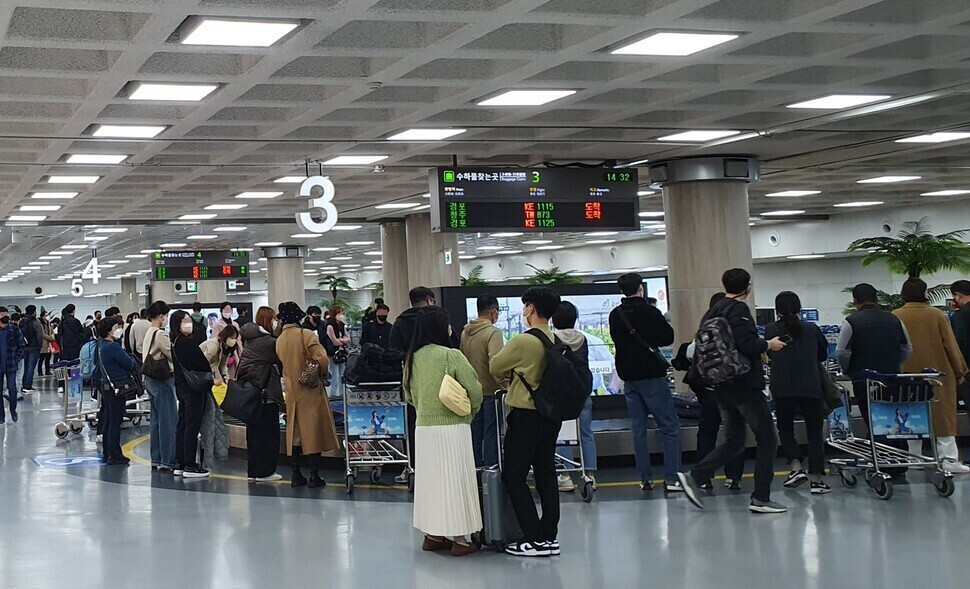
If the existing Jeju International Airport (Jeju Airport) is prioritized as proposed by Jeju Special Self-Governing Province, and excess air travel demand is transferred to the proposed second airport, the second airport’s share of air traffic is estimated to be around 30–35%.
Attention is focusing on the final traffic-sharing ratio, as the draft Environmental Impact Assessment (EIA)—which the Ministry of Land, Infrastructure and Transport (MOLIT) is preparing after gathering opinions from the Korea Airports Corporation (KAC)—will include a route allocation plan for the two airports.
Attending the Environment and Urban Committee meeting during the 456th Jeju Provincial Council’s 2nd regular session, which resumed on the 19th, Song Chang-yoon, Director of Communication and Second Airport Affairs for Jeju Province, explained, "We allocated demand between the two airports considering residents' convenience and the impact on the local economy."
Current air travel demand in Jeju is around 29 million passengers annually, and it was estimated during the second airport project planning that demand could grow up to 41 million passengers.
Amid over a decade of conflict surrounding the second airport, nothing has been finalized regarding how routes will be distributed between the two airports. However, past discussions have mentioned scenarios such as: ▲ Existing Jeju Airport handling 50% of domestic flights, while the second airport handles 50% of domestic flights and 100% of international flights; or ▲ Each airport splitting both domestic and international flights 50–50.
The maximum capacity of the existing Jeju Airport, which Jeju Province plans to prioritize, is estimated at 30 million passengers per year. However, the aviation industry believes terminal congestion and aviation safety issues have already reached their limits.
After gathering feedback from the aviation industry and other stakeholders, Jeju Province projected that the second airport could absorb approximately 12 to 15 million passengers annually.
When questioned during the meeting about Jeju Province’s response measures—including route allocation and conflict resolution—Director Song stated, "Jeju’s current air demand is 29 million, and we analyze it will grow to a maximum of 41 million. The existing airport's capacity limit is 30 million, and we have determined it has already reached that threshold."
He added, "I understand the Korea Airports Corporation submitted its opinion from a management perspective, such as airport operational efficiency. MOLIT will mediate between the opinions of Jeju Province and KAC, and we expect the opinions of Jeju residents to be fully reflected."
Unlike the 50–50 split mentioned in previous procedures, the second airport's share would drop to the 30–35% range under this proposal.
Based on the projected maximum demand of 41 million passengers, the second airport's share would peak at around 35%, and it could be even lower depending on actual future air travel demand.
Earlier on the 17th, Jeju Province submitted its official opinion to the Jeju Regional Office of Aviation, outlining four key principles: ▲ Prioritizing the use of the existing Jeju International Airport ▲ Having the second airport absorb excess air demand ▲ Considering the revitalization of the local economy ▲ Allowing flexible adjustments based on future changes in conditions.
When MOLIT requested input on route allocation between the two airports, Jeju Province stated that it submitted its proposal after considering resident mobility convenience, balanced regional development, and economic effects.
[Copyright (c) Global Economic Times. All Rights Reserved.]