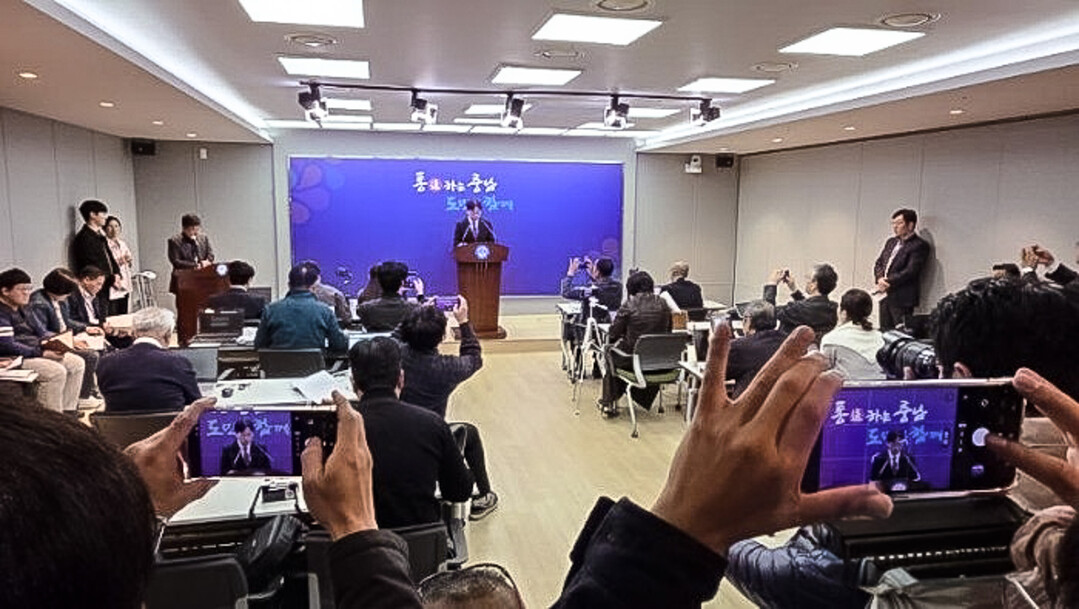
Chungnam Province has formulated and begun implementing an emergency measure to eliminate care gaps for high-risk children with developmental disabilities and their families.
Koo Sang, Director-General of the AI Basic Society, Health and Welfare Bureau, held a press conference at the provincial government press center on the 17th, announcing a strengthened "High-Risk Developmental Disability Children Care System" featuring:
A province-wide household survey
Expansion of care infrastructure
Reinforcement of weekend and holiday care
Medical and psychological support
This measure was prompted by the developmental disability child death incident that occurred in Cheonan on the 12th. It focuses on proactively identifying vulnerable children and bridging gaps in the local care system to alleviate the care burden on families.
As of 2025, there are 4,022 children with developmental disabilities in the province, accounting for 78.3% of the 5,134 registered children with disabilities. Among them, approximately 5%—around 200 children—are estimated to be in the high-risk group.
The core issues highlighted are the lack of a sufficient survey system to identify high-risk children and the inadequacy of care infrastructure tailored to their specific needs.
Currently, the province has only one emergency care center, where usage is restricted to a maximum of 7 days per instance and up to 30 days per year. Furthermore, care institutions for children with the most severe developmental disabilities are limited to adults, resulting in a shortage of facilities for children and ongoing care gaps during Sundays, holidays, and school vacations.
To address this, the province will first conduct a comprehensive household survey and provide tailored support for high-risk developmental disability children.
The survey will primarily target Cheonan, Asan, and Dangjin, where 57% of the province’s children with developmental disabilities reside. It will involve home visits, living condition checks, risk factor assessments, and evaluations of support needs.
Based on the survey results, the province will connect families with necessary services such as parenting support, family respite, psychological therapy, and behavioral intervention, followed by ongoing monitoring of service implementation and risk factors.
To expand care infrastructure, the province plans to install additional emergency care centers accessible to children and establish "Chungnam-style Care Institutions for Children with Severe Developmental Disabilities," offering 1-on-1 customized 24-hour care and daily living training. The province also plans to establish definitions and criteria for determining severe developmental disabilities and request government institutional improvements.
To reinforce after-school, weekend, and holiday care, four after-school care base centers will be designated in Cheonan, Asan, Seosan, and Dangjin to support care during periods when existing services are unavailable.
Finally, to strengthen medical and caregiver psychological support, the province will consult with regional medical institutions to designate a hub hospital and behavioral development promotion center for individuals with developmental disabilities.
In addition, parents of high-risk developmental disability children will receive priority support at the upcoming "Disability Family Healing Center," and home-visit psychological counseling services will be provided for caregivers who have difficulty leaving home due to caregiving responsibilities.
Koo Sang, Director-General of the AI Basic Society, Health and Welfare Bureau, stated, "Through the implementation of these measures, we will first identify vulnerable families and connect them with necessary services," adding, "We will build a robust care, therapy, and family support system hand-in-hand with the local community and experts."
[Copyright (c) Global Economic Times. All Rights Reserved.]